PSSR Inspection Guide for Coffee Shops
Every commercial espresso machine in the UK falls under the Pressure Systems Safety Regulations 2000 (PSSR). Here's what an inspection covers, how often it's required, and how to prepare your café so the test passes the first time.
What is PSSR and why does it apply to espresso machines?
The Pressure Systems Safety Regulations 2000 require the user of any relevant pressure system to have a Written Scheme of Examination (WSE) drawn up by a competent person, and to have that system examined at the intervals the scheme sets. A commercial espresso machine contains a steam boiler operating above 0.5 bar — that puts it squarely inside scope.
Responsibility sits with the user of the equipment (the café owner or operator), not the manufacturer or installer. If the HSE inspects and the WSE or examination record is missing, the fine lands on the business.
How often is a PSSR inspection required?
There is no single statutory interval — the WSE defines it. For a typical café espresso machine the competent person will usually specify:
- Every 12 months for the routine in-service examination of the boiler, safety valve, and pressure controls.
- Every 14 months maximum between examinations (the HSE allows a small grace period but recommends staying inside the 12-month cycle).
- After any modification or repair to a pressure- containing component (boiler swap, valve replacement, new heat exchanger).
What a PSSR engineer actually checks
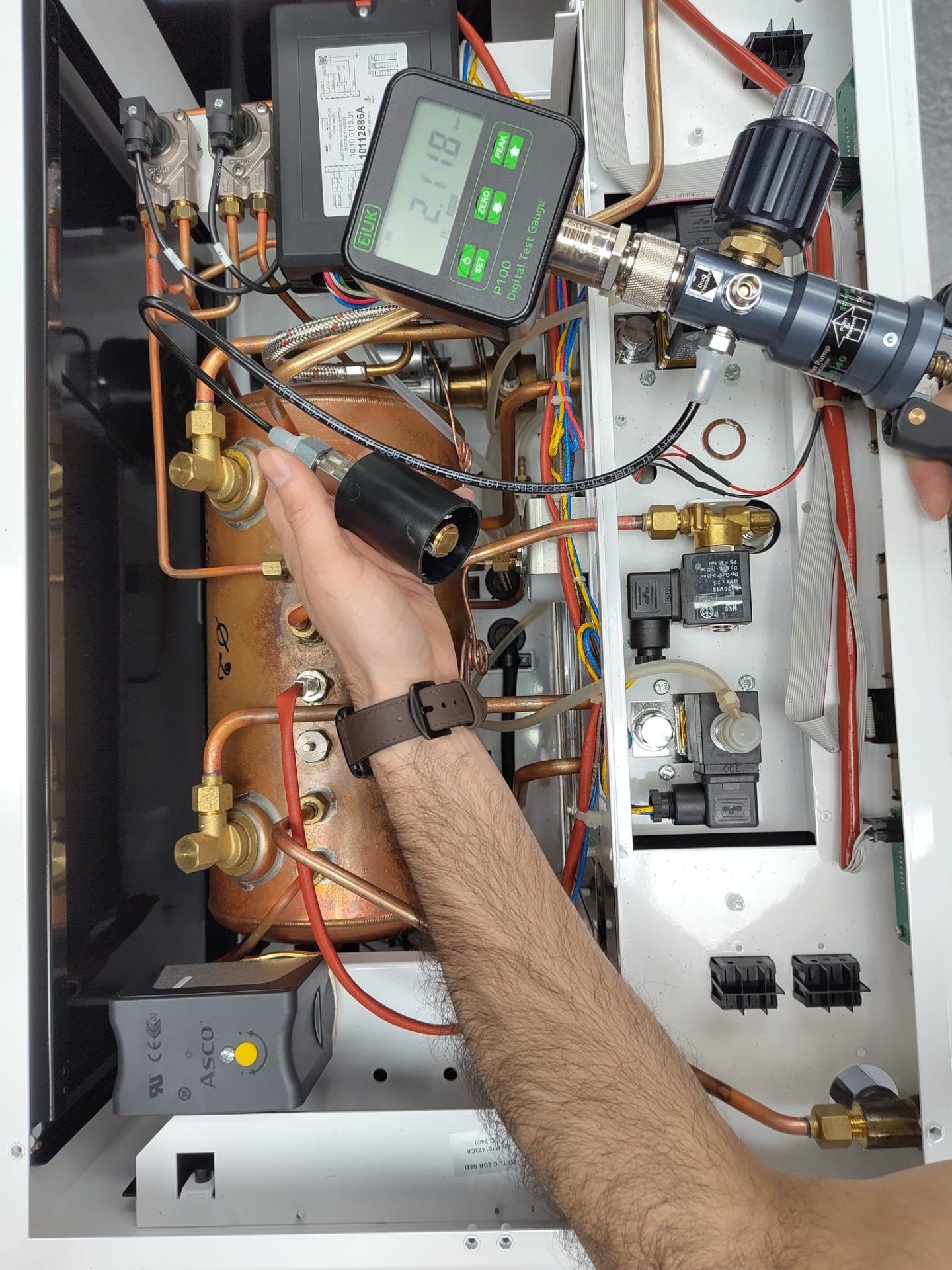
A Nine Bar PSSR examination follows the same routine the HSE expects a competent person to perform. On a typical 2- or 3-group machine that means:
- Boiler shell & fittings — visual inspection for corrosion, scale build-up, and weld integrity.
- Safety valve — function test, lift pressure verified against the boiler's design pressure, and the valve certified or replaced.
- Pressure gauge & pressurestat — accuracy check against a calibrated reference, cut-out tested.
- Vacuum valve & anti-suction valve — operation confirmed.
- Element / heat exchanger — insulation resistance and earth bonding measured.
- Hydraulic pressure test where the WSE requires it — typically at 1.5× working pressure.
- Written report issued with any defects, the date of the next examination, and (if needed) immediate enforcement actions.
How to prepare your café for the visit
- Schedule outside service hours. The machine has to come off, cool down, and have the boiler depressurised — plan for 90–120 minutes of downtime per machine.
- Have the paperwork ready. Original installation certificate, the current WSE, and the previous examination report.
- Descale beforehand. Heavy scale on the safety valve seat is the single most common cause of a failed lift test.
- Clear access to the back of the machine. The engineer needs to reach the boiler drain, element terminals, and pressurestat.
- Flag any recent faults. Pressure creep, weeping valves, or intermittent cut-outs — tell the engineer before they start.
What happens if the machine fails?
A failure is recorded as either a defect requiring attention before the next examination or an imminent dangernotice. The second category means the machine is taken out of service on the spot and the HSE is notified. Most failures we see are repairable the same day — a replacement safety valve, a new pressurestat, or a descale.
Need a PSSR examination in the Scottish Borders?
Nine Bar covers cafés and roasters across the Borders and the south-east of Scotland with same-week appointments.
Book an inspection →